
Information Returns in Canada (T4, T4A, T5, T3)
What Are Information Returns in Canada?
Every business in Canada may be required to file information returns with the Canada Revenue Agency (CRA). These returns report income paid to employees, shareholders, or contractors, and ensure proper compliance with Canadian tax law.
Most Common Information Returns in Canada
The four most common CRA information returns businesses file are:
-
T4 slips – for employment income
-
T5 slips – for investment income such as dividends or interest
-
T4A slips – for pensions, annuities, or self-employment/contract income
-
T3 slips – for income from trusts and estates
Why Filing Information Returns Matters
Filing these information returns accurately and on time helps businesses:
-
Avoid CRA penalties and interest for late or incorrect slips
-
Stay compliant with Canadian tax reporting requirements
-
Provide recipients with accurate tax slips for their personal or corporate tax filings
Employer and Business Obligations for Information Returns
In addition to submitting information returns to the CRA, businesses must provide copies of these slips to the individuals or companies who received:
-
Salary or wages
-
Dividends or interest
-
Pension or annuity payments
-
Contract or self-employment payments
Purpose of Information Returns in Canada
The main purpose of T4, T4A, T5, and T3 slips is twofold:
-
To ensure all income paid and taxes withheld by your business are properly reported to the CRA.
-
To provide recipients with the necessary slips so they can accurately file their personal or corporate tax returns.
Tax Filing Support for Businesses
At MJ Professionals, we take stress out of tax compliance in Canada. Our team ensures your information returns are prepared accurately and filed on time, so you never have to worry about penalties or missed deadlines. By letting us handle the details, you can stay focused on what matters most—running your business and implementing strategies to grow and succeed.
The 4 Most Common Information Slips in Canada
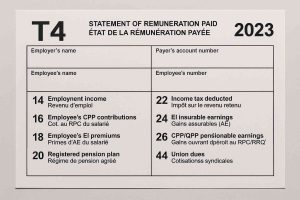
1. T4 – Statement of Remuneration Paid (Employment Income)
If you hire employees during the year and pay salary, wages, or other taxable amounts, you must prepare a T4 slip and file it with the CRA by the end of February following the calendar year.
You must also provide each employee with a copy of their T4 slip, which they will use to report their employment income when filing their personal tax return.
The CRA uses the amounts reported on the T4 to:
-
Verify taxes withheld
-
Match them with the remittances made during the year
If there is a shortfall, you must pay the difference. If there is an overpayment, it will be refunded or credited.
Taxable Benefits Reported on T4 Slips
T4 slips also report taxable employee benefits in specific boxes. Employers are responsible for correctly calculating benefits such as:
-
Standby charges
-
Employee loans
-
Allowances
13 Most Common Boxes Used on T4 Slips in Canada
Income Boxes
-
Box 14 – Employment Income: Total salary, wages, bonuses, and other taxable employment income before deductions.
-
Box 40 – Other Taxable Allowances and Benefits: The value of taxable benefits (e.g., employer-paid health benefits, company car, housing allowance).
-
Box 42 – Commissions: Income earned through sales commissions.
Deduction Boxes
-
Box 16 – Employee’s CPP Contributions (see 2025 CPP maximums).
-
Box 18 – Employee’s EI Premiums (see 2025 EI maximums).
-
Box 22 – Income Tax Deducted: Federal and provincial income tax withheld at source.
Employer Contribution Boxes
-
Box 24 – EI Insurable Earnings
-
Box 26 – CPP/QPP Pensionable Earnings
Other Common Boxes
-
Box 44 – Union Dues
-
Box 46 – Charitable Donations
-
Box 50 – RPP Contributions
-
Box 52 – Pension Adjustment
-
Box 85 – Employee-Paid Health Premiums
2. T5 Slips – Statement of Investment Income
A T5 slip is issued when you pay investment income to shareholders, investors, or individuals. This may include:
-
Dividends from Canadian corporations
-
Interest on bonds, term deposits, or other investments
-
Certain other investment-related payments
You must also file a T5 Summary with the CRA. The deadline to file T5s and provide slips to recipients is the last day of February following the calendar year.
Dividend Income Reported on T5 Slips
-
Box 10 – Actual Amount of Dividends (Other than Eligible Dividends)
-
Box 11 – Taxable Amount of Dividends (Other than Eligible Dividends)
-
Box 12 – Dividend Tax Credit (Other than Eligible Dividends)
-
Box 24 – Actual Amount of Eligible Dividends
-
Box 25 – Taxable Amount of Eligible Dividends
-
Box 26 – Dividend Tax Credit (Eligible Dividends)
Interest Income and Other Boxes
-
Box 13 – Interest from Canadian Sources
-
Box 15 – Foreign Income
-
Box 16 – Foreign Tax Paid
-
Box 17 – Royalties
-
Box 18 – Capital Gains Dividends
-
Box 21 – Reportable Amount of Dividends (Capital Gains Dividends)
3. T4A Slips – Pensions, Annuities, or Self-Employment/Contract Income
The T4A slip is an information return issued by businesses, organizations, or institutions to report income other than employment income. Unlike the T4, the T4A covers contract/self-employment payments, pensions, and more.
Who Receives a T4A?
-
Self-employment/contract income (fees for services)
-
Pension or retirement income (RRSP annuities, RRIF payments, or other pensions)
-
Scholarships, bursaries, or research grants
-
Lump-sum payments, death benefits, or service fees
Who Issues a T4A?
Businesses, institutions, or organizations must issue a T4A if they pay $500 or more in a year. Some issue slips for smaller amounts as well.
Reporting T4A Income on Your Taxes
-
Income must be included on your T1 personal tax return.
-
Pension income → Line 11500
-
Other income → Line 13000
-
Scholarships → Line 13010
Key Points About T4A Slips
-
Keep all T4A slips with your tax records.
-
Verify amounts match your invoices or statements.
-
Self-employment income on a T4A may allow for expense deductions.
4. T3 Slips – Income From Trusts and Estates
The T3 slip (Statement of Trust Income Allocations and Designations) reports income from trusts, estates, mutual funds, and ETFs.
Who Receives a T3?
-
Capital gains from trusts
-
Interest income
-
Dividends (Canadian or foreign)
-
Foreign income and taxes paid
-
Return of capital (ROC)
Who Issues a T3?
-
Trusts, mutual fund companies, investment firms, or estate administrators issue T3 slips if you earned more than $100 in the year.
When Are T3 Slips Issued?
T3 slips are usually sent later than T4 and T5 slips. The deadline is March 31 following the calendar year.
Reporting T3 Income on Your Taxes
-
Each box corresponds to a specific type of income.
-
Some amounts (like ROC) affect your adjusted cost base (ACB).
-
Even if you don’t receive a T3, you must report income earned.